SUSANA BACA / “Maria Lando”
To listen to Susana Baca’s music is to become immersed in the history of her people, the descendants of enslaved Africans in the country of Peru. Some of Susana’s repertoire is recent, but a lot of it is years and years old. Baca says that she chooses the songs she sings not just because she likes them, but also to honor both those who wrote the songs and those who the songs are about. You might say that Susana Baca’s music catalog is the world’s most beautiful, and funkiest, history lesson.
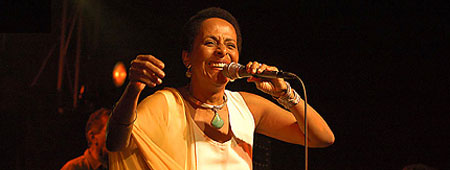 Baca’s personal history is as fascinating as her music. From her beginnings, growing up in a servant’s alley in Lima, Peru, to her current status as a internationally-known diva of song, it’s been an inspiring and unlikely journey. But let’s let Susana herself tell it. Along the way, we’ll check out some of her music.
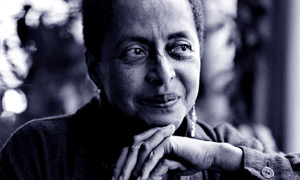 I grew up with music all around me. My father played the guitar. In Lima we lived on a small street, really more of an alleyway where many servants lived, off the main streets past the fancy neighborhoods. My father was the official musician of the alley. Whenever there was a neighborhood party, he would be called to play. He played serranitas which are tales of the Golondrinos, people who came from Los Andes near the coast in the time of cotton-picking. My father learned the serranitas from them in his childhood. They are sung at Christmas: (singing) “Ay, my dove is flying away, she’s gone. Let her go, she’ll soon return.”
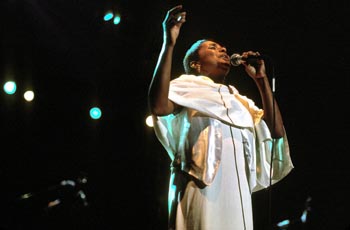 This is the song that led to Baca’s international fame. David Byrne (ex-lead singer of the well-known rock band Talking Heads and current record label owner and champion of South American music) fell in love with Baca’s music and included her version of “Maria Lando” on a compilation called The Soul Of Black Peru. The whole collection is good, but even before she became famous, Baca’s song stood out.
In prosaic yet beautifully-worded verse, the song begins with a description of the early morning hours in a small town of Peru:
This is the song that led to Baca’s international fame. David Byrne (ex-lead singer of the well-known rock band Talking Heads and current record label owner and champion of South American music) fell in love with Baca’s music and included her version of “Maria Lando” on a compilation called The Soul Of Black Peru. The whole collection is good, but even before she became famous, Baca’s song stood out.
In prosaic yet beautifully-worded verse, the song begins with a description of the early morning hours in a small town of Peru:
The dawn breaks like a statue Like a winged statue spreading across the city And the noon rings, a bell made of water A golden singing bell that keeps us from feeling aloneBut the rest of the song talks about a servant girl named Maria Lando, for whom “there is no dawn,” “there is no noon,” there is only “lack of sleep,” “suffering,” and “work for others.” The song was composed by Chabuca Granda, a noted Peruvian composer who Baca often mentions as one of her heroes and mentors.
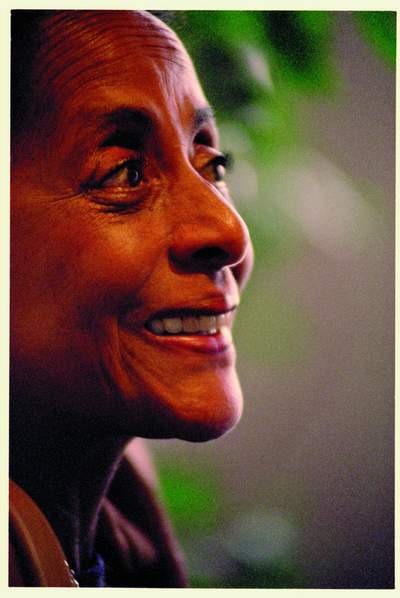 My parents didn't support this idea in the beginning. My father was strongly opposed to the idea, and my mother originally wanted me to be a teacher. Women in Peru weren't supposed to sing on stage. Chabuca Granda told me that she used pseudonyms for her first compositions. Her name did not appear anywhere, otherwise, she would have been ostracized by her family. It was terrible for a woman to be an artist. It was seen as a lowly profession, like prostitution. I tried not to become a professional singer, mainly for my mother’s sake. She thought I wouldn’t be able to earn a living. That’s my mother’s image of musicians. My mother told me many stories about musicians who were not famous like Felipe Pingo, a renowned musician and composer who died of tuberculosis. She said, "This is the destiny of my daughter," and she pushed me to become a teacher. I liked studying to be a teacher; I dedicated myself to being a singer later.
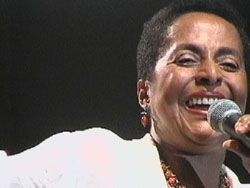 I came face to face with the past and I had to be strong. It’s something that everyone of African origin has to do because our past is immersed in the history of slavery; and that has to be confronted and acknowledged. Ricardo [Baca’s husband] calls it an exorcism. I read a lot; it wasn’t very pleasant. There were moments I didn’t want to continue, I didn’t want to know anymore about the atrocities of history. There’s really no access to this information in Peru, for example, because no one has written about it in history books.
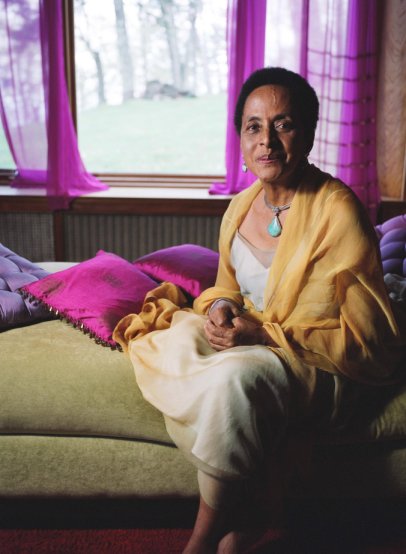 Sometimes, the racism and self-hate suffered by black people all over the Americas seems virtually universal. This is the reason that songs of black pride are so important—they aren’t about self-aggrandizement or feelings of superiority. Instead, they are intended to counteract the ceaseless down-pression of being a black person in a hostile environment. Many of Baca’s tunes—including this one—are ‘black pride’ songs. “Caras Lindas” (“Beautiful Faces”) begins:
Las caras lindas de mi gente negra Son un desfile de melaza en flor Que cuando pasan frente a mi se alegra De su negrura todo el corazónThe beautiful faces of my black people Are a parade of molasses in bloom And when they pass before me Their blackness cheers my heart The hesitating, stop-and-start rhythm of this song (and many other Baca songs) is a centuries-old style called landó which originated with the African slaves who were brought to Peru to work the fields and mills.
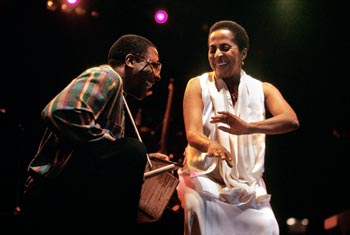 The common ground between jazz and my music is the element of surprise that the different rhythms in Peruvian music provoke and the surprise of the jazz jam session. I never thought that I was making jazz music until I saw people coming to my concerts from that world. We also leave some spaces for improvisation for the musicians, just like jazz.
When I first met my husband, Ricardo, I was active as a musician, but everything moved so slowly. I dedicated myself to music, and couldn’t devote myself to looking for work or figuring out how to record an album. I thought that if I worked hard enough, I’d find someone who was interested in working with me. I realized, after many years, that no one was interested in what I was singing, which was poetry. I was black, singing black music. It was a big problem. We knocked on so many doors looking for backers. Then one fine day, Ricardo said, "I’m not looking anymore. I’m not knocking on anymore doors." We held a concert and recorded it. That’s how I made my first recording. We created our own record label together.
The common ground between jazz and my music is the element of surprise that the different rhythms in Peruvian music provoke and the surprise of the jazz jam session. I never thought that I was making jazz music until I saw people coming to my concerts from that world. We also leave some spaces for improvisation for the musicians, just like jazz.
When I first met my husband, Ricardo, I was active as a musician, but everything moved so slowly. I dedicated myself to music, and couldn’t devote myself to looking for work or figuring out how to record an album. I thought that if I worked hard enough, I’d find someone who was interested in working with me. I realized, after many years, that no one was interested in what I was singing, which was poetry. I was black, singing black music. It was a big problem. We knocked on so many doors looking for backers. Then one fine day, Ricardo said, "I’m not looking anymore. I’m not knocking on anymore doors." We held a concert and recorded it. That’s how I made my first recording. We created our own record label together.
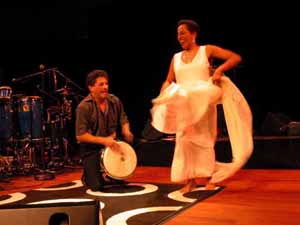 One of the other things I did to survive monetarily in Peru was teach dance, which I really liked because it was within my realm. I’d go to schools and teach the kids, kids that are now grown up and will never forget those classes. Now they’re professed lovers of Afro-Peruvian culture. I wanted my own dance space to keep teaching. So we sank everything into building an institute in Chorrillos offering rehearsal space to young musicians, a library and a place where they could listen to music. We gave singing classes, dance classes, everything. It’s still operating and people come from everywhere to use the resources.
Younger musicians are mixing rock with festejo, with rap, with salsa. People are looking for a new sound, and they don't respect any boundaries. There's not so much a movement, but we've opened our Institute so that people can come in and listen, read, and learn about the music. I think a movement will come, a group of musicians who come together—right now there's no centralized place for the artists. That's what we're trying to do with our Institute.
One of the other things I did to survive monetarily in Peru was teach dance, which I really liked because it was within my realm. I’d go to schools and teach the kids, kids that are now grown up and will never forget those classes. Now they’re professed lovers of Afro-Peruvian culture. I wanted my own dance space to keep teaching. So we sank everything into building an institute in Chorrillos offering rehearsal space to young musicians, a library and a place where they could listen to music. We gave singing classes, dance classes, everything. It’s still operating and people come from everywhere to use the resources.
Younger musicians are mixing rock with festejo, with rap, with salsa. People are looking for a new sound, and they don't respect any boundaries. There's not so much a movement, but we've opened our Institute so that people can come in and listen, read, and learn about the music. I think a movement will come, a group of musicians who come together—right now there's no centralized place for the artists. That's what we're trying to do with our Institute.
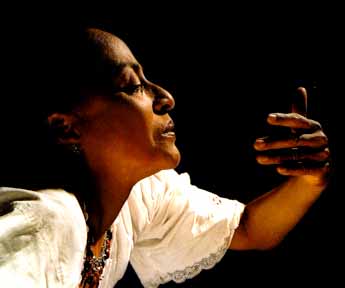 I would like to expand Negro Continuo, our institute. We have expanded a lot lately, we made a recording space. There are so many talented young people with tons of compositions who can’t record them. They’re not commercial, so record labels aren’t interested. It’s the same old story. I also have a bunch of things to record—songs I want to leave on records. It’s important, because young blacks are not proud of being black. There is an extraordinary singer in Peru who’s Afro-Peruvian, like I am, but she doesn’t want to be black. She doesn’t feel it. Why? Because she doesn’t know about the past, she doesn’t realize how important the African presence is. Blacks are always stigmatized. The result of that stigmatization is that young black people do whatever they can not to feel black.
My CD doesn’t sell [in Peru]. People look for it and they can’t find it because the distributors aren’t interested in carrying it. My dream is to sing in my own country, [but] to give a concert in my own country, I’d have to pay for it myself. People are very poor, you have to charge practically nothing so that people will come. I’d like to give concerts for free, but it’s expensive. We’ve gone to sing in dining halls, public cafeterias.
I was on CNN in Peru the other day, and afterwards I was walking in the street and the people recognized me. I went to the market and people ran after me, called my name. They hugged me and told me nice things. And when I do interviews on the radio and sing, people call in and ask, "But when are you going to perform in Peru?"
I would like to be remembered for my voice, of course. But also for helping to spread the music of my ancestors—all those people who were never recognized for their work or for their beautiful culture.
—Mtume ya Salaam
Susana Baca’s life story is taken from several interviews that I found online. If you’d like to read the interviews in their entirety, click the links below.
- Interview reprinted on the ‘Artist Info’ page of Susana Baca’s website. Full article available at http://www.luakabop.com/susana_baca/
- Interview at Afropop Worldwide. Full article available at http://www.afropop.org/explore/artist_info/ID/263/Susana%20Baca/
- Interview with Bombsite.com. Full interview available at http://www.bombsite.com/baca/baca2.html
- Article called “Black Light.” Available at http://music.barnesandnoble.com/features/interview.asp?z=y&NID=161880&project_id=1000102
Once one is full
It is not necessary—nor is it healthy—to eat more once one is full.
—Kalamu ya Salaam
Say what?
Baba, maybe I'm missing something obvious, but what's that supposed to mean?
—Mtume ya Salaam
Enuf is enuf
It means you said all that needs to be said and anything I might add would be superfluous.
—Kalamu ya Salaam
I would like to expand Negro Continuo, our institute. We have expanded a lot lately, we made a recording space. There are so many talented young people with tons of compositions who can’t record them. They’re not commercial, so record labels aren’t interested. It’s the same old story. I also have a bunch of things to record—songs I want to leave on records. It’s important, because young blacks are not proud of being black. There is an extraordinary singer in Peru who’s Afro-Peruvian, like I am, but she doesn’t want to be black. She doesn’t feel it. Why? Because she doesn’t know about the past, she doesn’t realize how important the African presence is. Blacks are always stigmatized. The result of that stigmatization is that young black people do whatever they can not to feel black.
My CD doesn’t sell [in Peru]. People look for it and they can’t find it because the distributors aren’t interested in carrying it. My dream is to sing in my own country, [but] to give a concert in my own country, I’d have to pay for it myself. People are very poor, you have to charge practically nothing so that people will come. I’d like to give concerts for free, but it’s expensive. We’ve gone to sing in dining halls, public cafeterias.
I was on CNN in Peru the other day, and afterwards I was walking in the street and the people recognized me. I went to the market and people ran after me, called my name. They hugged me and told me nice things. And when I do interviews on the radio and sing, people call in and ask, "But when are you going to perform in Peru?"
I would like to be remembered for my voice, of course. But also for helping to spread the music of my ancestors—all those people who were never recognized for their work or for their beautiful culture.
—Mtume ya Salaam
Susana Baca’s life story is taken from several interviews that I found online. If you’d like to read the interviews in their entirety, click the links below.
- Interview reprinted on the ‘Artist Info’ page of Susana Baca’s website. Full article available at http://www.luakabop.com/susana_baca/
- Interview at Afropop Worldwide. Full article available at http://www.afropop.org/explore/artist_info/ID/263/Susana%20Baca/
- Interview with Bombsite.com. Full interview available at http://www.bombsite.com/baca/baca2.html
- Article called “Black Light.” Available at http://music.barnesandnoble.com/features/interview.asp?z=y&NID=161880&project_id=1000102
Once one is full
It is not necessary—nor is it healthy—to eat more once one is full.
—Kalamu ya Salaam
Say what?
Baba, maybe I'm missing something obvious, but what's that supposed to mean?
—Mtume ya Salaam
Enuf is enuf
It means you said all that needs to be said and anything I might add would be superfluous.
—Kalamu ya Salaam
This entry was posted on Sunday, August 13th, 2006 at 12:45 am and is filed under Contemporary. You can follow any responses to this entry through the RSS 2.0 feed. You can leave a response, or trackback from your own site.
6 Responses to “SUSANA BACA / “Maria Lando””
August 13th, 2006 at 4:41 pm
Thank you. I have enjoyed our sister since I first found the Black Peru CD years ago. As I read the review, I saw visions of Sade, Sara Taraves, and Cesaria. It is amazing to read of the lack of historical knowledge by those of African descent in Peru. The powers-that-be have done their job well. Kudos to Susana and Ricardo for doing their part…
August 13th, 2006 at 7:38 pm
Thanks ever so much for introducing me to Susana Baca. Rich. Sensual. That African ingredient is something else.
August 14th, 2006 at 3:47 pm
I bought The Soul of Black Peru in 1996 in an HMV in Hong Kong of all places. I’ve been in love with her voice ever since.
August 17th, 2006 at 5:21 am
i found “the soul of peru” cd years ago in dc. i didnt understand much of what she was saying but i damn sure felt it. this was definitely a highlight if not the highlight of the cd for me. if i remember correctly there were english lyrics in the booklet and it also read like a beautiful poem as was mentioned before. i’m not familiar with her other work, but maria lando is certified phonkey!
September 23rd, 2006 at 5:07 am
Susana is one, if not the best, Peruvian singer today. I enjoyed meeting her when I used to live in Barranco next to Chorrillos her hometown where she has a Afro Peruvian music center. Susana vale un Peru!
August 8th, 2009 at 9:51 pm
You still sing the Music of mt soul!!!
Momentos Iluminados,
Avotcja
Leave a Reply
| top |